How we map and develop organisational culture

Decades of research, built into a platform that shows what people actually prioritise, not what they say they do. The result is culture data you can base decisions on, track over time, and hold against a benchmark of thousands of professionals.

hva-vi-gjor-grafikk (1)

10K

unike brukere

160+

organisasjoner kartlagt

1M

data-baserte prioriteringer

Values drive the choices people make every day

When someone picks one important thing over another, that choice shows what matters more to them. Collect enough of those choices and you can see what your organisation really runs on. Values are learned, which means they can change. But you have to see them first.


Built for organisations in change

1 (1)
6
10
5
7
3
13
12
11
Nibio
Startup lab
Siemens
Gutta på haugen - client logo
DNB
Akershus energi-1
Geno-1
Olso US-1
Vikenfiber-1
1a-ring-av-100-prikker

Values drive culture

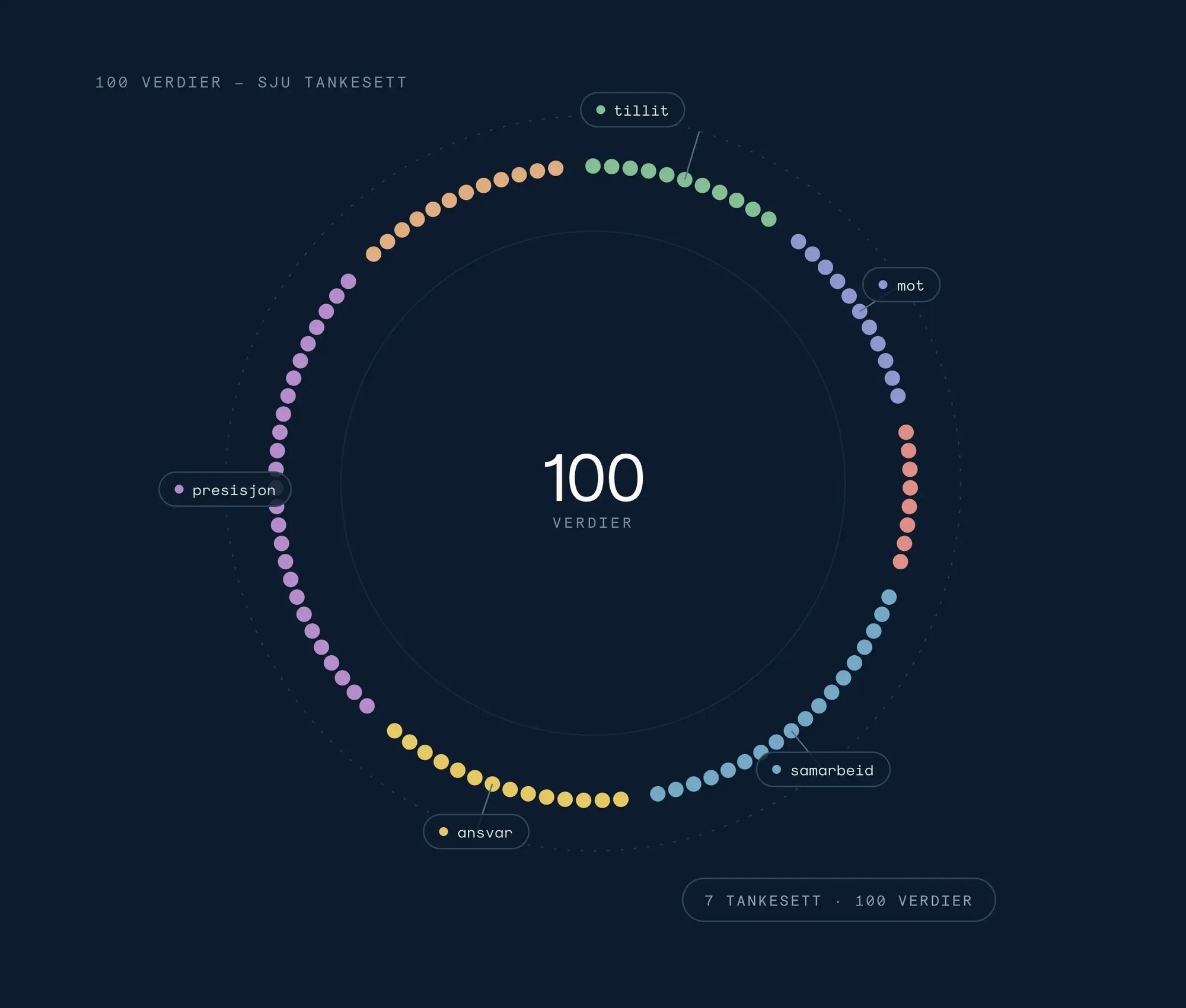
Values are drivers. They're the reason we act as we do, but they're largely unconscious and have long been hard to get hold of. We've mapped 100 values, each tied to one of seven mindsets, in a framework built on organisational psychology and culture research. That makes it visible why people act as they do, at individual, team and organisational level.

We make them visible

We don't ask people to describe the culture. We ask them to prioritise: four concrete actions at a time, one choice about which matters most right now. All four matter, so there's no right answer to give.

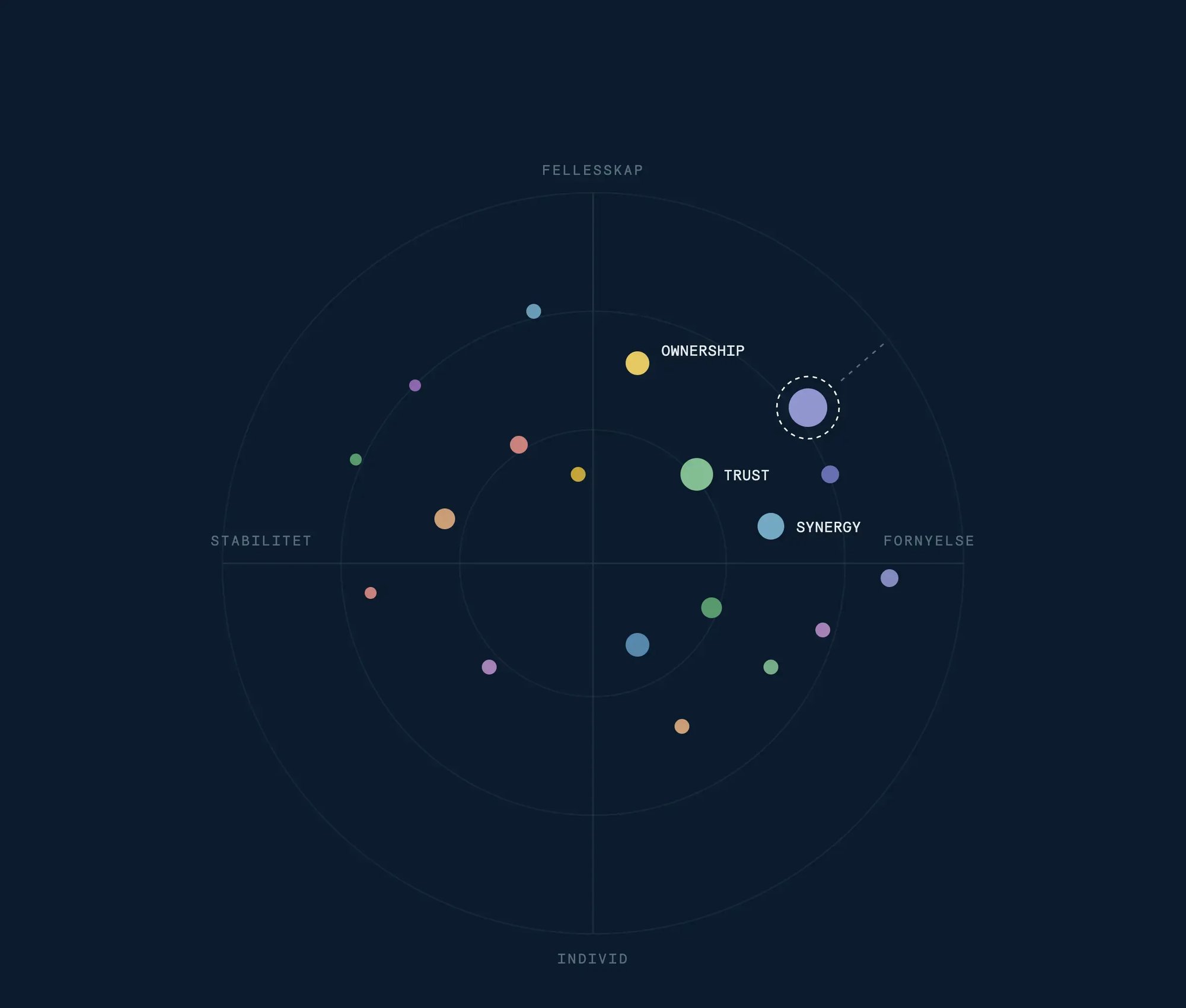
From those priorities we build a profile of what actually drives each person, ready in 30 minutes. Together they show the culture as it is, based on what people choose rather than what they say. Answers are anonymous unless someone chooses to share.
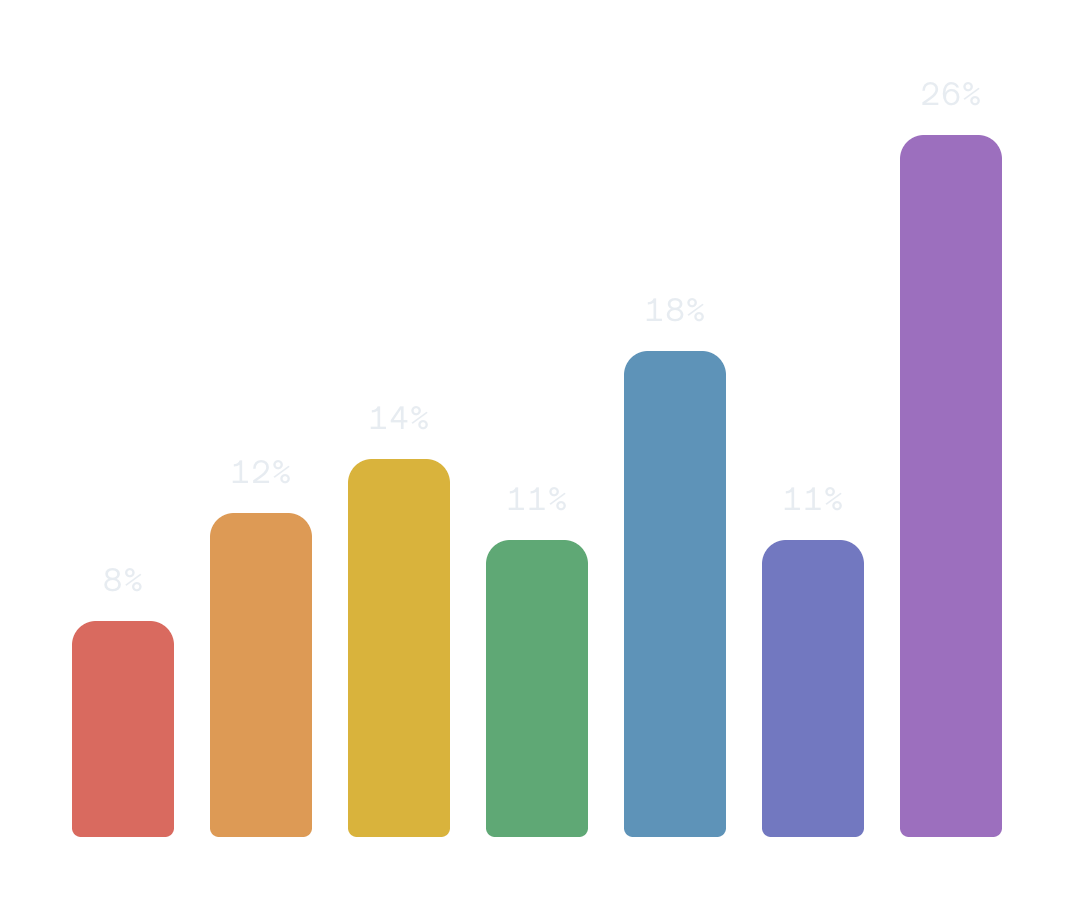
 

1b-mindset-soyler
3c-verdikart

From 100 values to your core values

A person typically acts on 8 to 10 of the hundred values. The ones that recur across an organisation become its real core values, whether anyone decided them or not.

That matters because values are the most scalable tool a leader has. Nobody can write a rule for every situation, but people who share the same priorities make the decisions leadership would have made, with no leader in the room.

So the question isn't whether you have values. It's whether the ones driving behaviour today are the ones your strategy needs, and if not, whether to change the values or change what gets attention.

One framework that reveals how culture shows up differently across every individual, team and function

Individual

Each person's values priorities reveal their preferred mindset — how they make decisions, lead, build relationships and respond to pressure. Because mindsets are largely unconscious, this data surfaces what self-reporting can't.

Team

Values data reveals a team's collective culture — where there's alignment and how the team is likely to behave during change. Teams with misaligned mindsets don't just underperform, they resist change without knowing why.


Organisation

Culture mapping reveals patterns across departments, functions and leadership layers. The gap between the culture leaders believe they have and the culture that is actually driving behaviour becomes visible.


Proven research. Translated into action.

The Culture Intelligence framework doesn't stand alone. It is built on some of the most robust and widely validated theories in organisational psychology, human development and change science — tested across more than 1,000 individual leaders, 50 leadership teams and 20 organisations across industries and geographies.

 
The ADKAR Change Model

Our culture change methodology is structured around the proven ADKAR framework — Awareness, Desire, Knowledge, Ability and Reinforcement. This ensures culture change is not just measured but actively driven through a structured five-phase process that embeds new behaviours into management systems rather than running as a parallel initiative.

David Rock's neuroscience-based model — Status, Certainty, Autonomy, Relatedness and Fairness — informs how we interpret resistance to change. When these five core human needs are threatened, resistance becomes the default response. CI identifies where these pressure points exist before they become barriers.

Our values framework draws on multiple foundational values researchers — Clare Graves' levels of human existence, Milton Rokeach's values theory, and Don Beck and Christopher Cowan's Spiral Dynamics — creating a multi-layered model that is more comprehensive than any single framework alone.

The hierarchy of human needs forms the developmental foundation for the seven mindset levels — from foundational security and belonging through to visionary purpose. Our model follows the same developmental sequence, recognising that each stage builds on and includes the previous.


Culture Intelligence was not built in a lab. It was forged through 25 years of real-world experience — from a values-driven merger integrating two global shipping companies across 72 countries, to building values-led brands, to leading commercial culture transformation projects across industries in the US, UK and Scandinavia. The methodology is grounded in what actually works when culture meets strategy under real business pressure.

Pioneer of values science and creator of the Hall Tonna values system — the original values mapping methodology that CI is directly built upon. Hall's work established that values can be precisely defined, linked to behaviours and measured systematically. CI has built on and extended this foundation since 1999.

Book a demo to see the method in practice

We'll walk you through a real culture map, the 100 values behind it, and what the picture tends to look like for organisations like yours.